
Data Analytics Team Assessment & Transformation Action Plan
Going from manual reporting to advanced analytics
Client Context
A fast-growing fintech organization operating at scale relied heavily on analytics to support operations, finance, risk, and strategic decision-making. Despite significant investment in data platforms and reporting, senior leadership observed that analytics outputs were not consistently driving decisions or delivering proportional business value.
The analytics function had evolved organically, resulting in fragmented products, high manual effort, and a growing disconnect between business needs and analytical outputs. Leadership commissioned a data analytics team assessment and transformation plan to reposition analytics as a decision-centric, scalable capability aligned with the company’s growth ambitions.
Key Challenges Identified
Limited Decision Impact
Dashboards and reports were largely descriptive and static, lacking:
Clear linkage to decision points
Actionable controls, targets, and alerts
Differentiation between strategic, tactical, and analytical use cases
This resulted in “noise-heavy” reporting and low stakeholder adoption.
Inefficient Delivery Model
High share of recurring manual reporting (≈65–70%)
Debugging dominated the delivery pipeline
Analytics backlog driven by unclear requirements and rework
The team spent disproportionate time maintaining outputs rather than generating insights.
Fragmented Analytics Landscape
Inconsistent metric definitions and undocumented methodologies
Parallel tooling (e.g., Alteryx workflows) increasing technical debt
Lack of a unified data modeling and instrumentation architecture
Skills & Operating Model Gaps
No standardized role definitions or skill expectations
Limited structured learning and knowledge sharing
Capacity allocation tied to departments rather than project needs
Transformation Objective
To transition the analytics function from report production to decision support, delivering scalable, trusted, and business-aligned analytics products.
The target state emphasized:
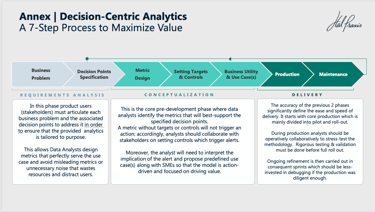
Decision-centric analytics
Self-served, validated, and noise-free dashboards
Strong governance, documentation, and validation
A motivated, skilled analytics squad operating under a clear delivery model
Transformation Approach
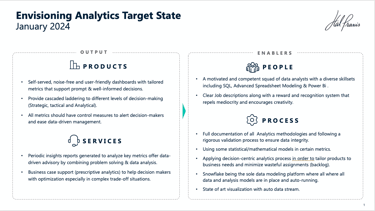
The transformation plan was structured around four coordinated pillars: Products, Services, Process, and People, supported by a unified data platform.
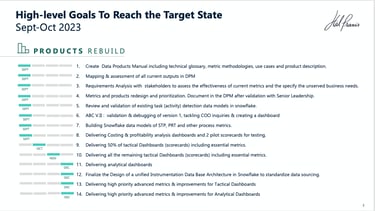
Analytics Products – Rebuild
Full inventory and assessment of existing dashboards and metrics
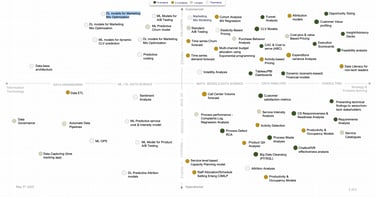
Redesign and prioritization of analytics products based on business decision needs
Creation of a Data Products Manual (DPM) documenting metric definitions, methodologies, use cases, and ownership
Delivery of standardized tactical scorecards and analytical dashboards
Validation and enhancement of cost, profitability, and process-performance models
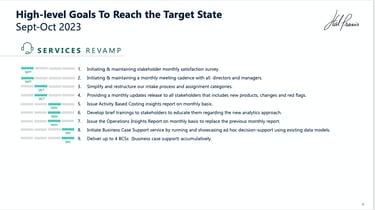
Analytics Services – Revamp
Introduction of structured stakeholder engagement (monthly satisfaction surveys and cadence meetings)
Simplified intake and assignment categorization to reduce waste
Regular analytics release notes highlighting changes, new products, and risks
Launch of Business Case Support (BCS) services providing prescriptive, decision-oriented analysis
Periodic insights reports replacing static operational reporting
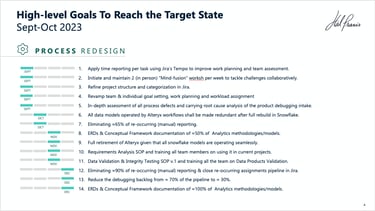
Analytics Processes – Redesign
Implementation of time tracking and workload planning to improve transparency and prioritization
Elimination of redundant manual reporting (target: ≈90%)
Migration to a single data modeling platform (Snowflake) and retirement of legacy tooling
Introduction of standardized SOPs for requirements analysis, data validation, and model testing
Formal documentation of analytics methodologies and conceptual frameworks
People & Capability Development
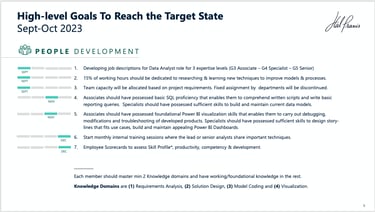
Definition of clear role profiles across three analyst levels (Associate, Specialist, Senior)
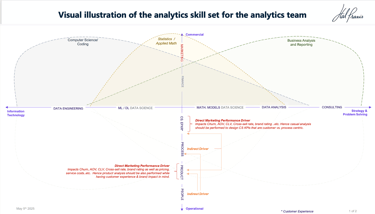
Minimum skill expectations across SQL, modeling, and visualization
Structured internal training and knowledge-sharing sessions
Individual scorecards to track productivity, skill growth, and contribution
Shift from fixed departmental assignment to demand-driven capacity allocation
Business Impact
More effective and Scalable Analytics
Analytics outputs can now support complex strategic, tactical, and operational decisions.
The analytics team can support growth without linear increases in headcount or technical complexity.
Analytics evolved from a reactive reporting function into a proactive advisory partner
Higher Productivity & Reduced Waste
Significant reduction in recurring manual reporting
Lower debugging backlog through better upfront requirements and validation
Faster delivery cycles with fewer rework loops
Stronger Governance & Data Integrity
Standardized metric definitions and validation processes
Improved auditability and confidence in reported numbers
This analytics assessment and transformation program repositioned the fintech’s analytics function as a decision-centric, scalable capability.
By aligning products, services, processes, and people around clearly articulated business decisions—and grounding execution in strong governance and a unified data platform—the organization laid the foundation for analytics that consistently delivers measurable business value rather than volume-driven outputs.
Deliverable Excerpts (Not Exhaustive)
© Hal Praxis 2025. All rights reserved.
Register Code: 304291595
Anapilio 30 Vilnius, Lithuania