
Financial Model For the Commercialisation Strategy of a Large-Scale Building Retrofitting Project
Turned a technically viable but financially uncertain initiative into a bankable investment
Client Context
An international sustainability NGO, in collaboration with national and municipal stakeholders, was supporting a large-scale energy efficiency initiative focused on the thermo-technical rehabilitation of aging precast residential buildings in the capital of a Central Asian country.
The city faced severe challenges related to energy inefficiency, heating system subsidies, and deteriorating residential building stock. While the technical feasibility of building retrofitting had already been validated, decision-makers lacked a robust financial and commercialization model to determine how the project could be financed, scaled, and sustained over time under local market constraints.
The NGO required a decision-support financial model to evaluate alternative delivery and financing strategies and to support engagement with international climate financiers, development banks, and government entities.
Key Challenges
High Energy Subsidies and Fiscal Pressure
District heating was heavily subsidized—covering more than 90% of actual costs—placing a growing burden on public finances. Planned subsidy reductions created uncertainty around future heating prices and revenue stability.
Market and Financing Constraints
Local inflation exceeding 5% annually resulted in high domestic interest rates
Commercial debt was prohibitively expensive
The local energy services (ESCO) market lacked maturity, technical capacity, and regulatory readiness
These factors limited the viability of traditional private-sector financing structures.
Fragmented Stakeholder Landscape
The project involved multiple actors, including:
Municipal authorities
National government bodies
Utility operators
International donors and climate funds
A neutral and transparent financial structure was required to align incentives and manage funds credibly.
Scale and Long-Term Sustainability
While the initial phase covered several hundred buildings, the full program was expected to scale to more than 1,000 buildings over time. Any proposed model needed to support multi-year deployment, reinvestment, and expansion.
Project Objective
To design and validate a financial and commercialization strategy that would:
Enable large-scale building retrofitting at the lowest possible cost
Minimize household financial burden
Leverage international climate finance effectively
Ensure long-term financial sustainability beyond the initial funding cycle
Solution Design
A comprehensive financial modeling framework was developed to assess and compare alternative project delivery and financing approaches under local economic and regulatory conditions.
Two business models were evaluated:
Version 1: Public–Private Partnership (ESCO-based model)
Version 2: Direct Contracting model via a dedicated Energy Efficiency Fund
The analysis ultimately demonstrated that a public, fund-based direct contracting model delivered superior outcomes in terms of cost efficiency, scalability, and risk allocation.
Financial Framework & Assumptions
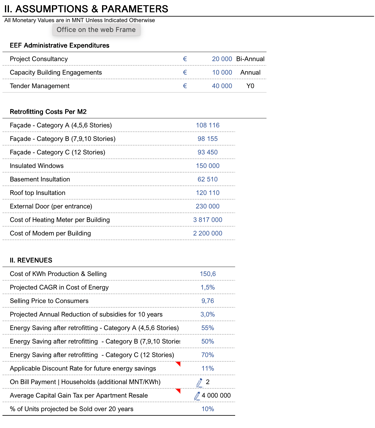
A modular financial model was constructed with clearly defined and auditable assumptions, including:
Retrofitting costs and energy savings (45–65%)
Inflation, interest rates, and financing terms
Government subsidy trajectories
Property value appreciation following retrofit (30–50%)
The model allowed stakeholders to stress-test assumptions and assess sensitivities.
Energy Efficiency Fund (EEF) Structure
A non-profit Energy Efficiency Fund was designed as a central financing vehicle:
Capitalized through international climate finance grants, development bank funding, and government contributions
Operating as a creditor, providing concessional loans rather than grants
Governed independently to ensure transparency and financial discipline
The Fund enabled recycling of capital, allowing future projects to be financed beyond the initial intervention.
Revenue & Repayment Mechanisms
Multiple revenue streams were modeled to ensure solvency while keeping household costs low:
Surplus generated by fixing consumer energy bills during subsidy reductions
Debt repayment over a 10-year horizon
Potential capture of property value uplift through transaction-based mechanisms
Interest income to cover fund administration and technical oversight
Cost Optimization Strategy
To minimize total project cost:
Centralized procurement of construction materials
Competitive and transparent tendering of construction companies
Temporary tax incentives for participating contractors
Contractor-backed maintenance obligations for the first 10 years
These measures significantly reduced bill-of-materials and service delivery costs.
Key Deliverables
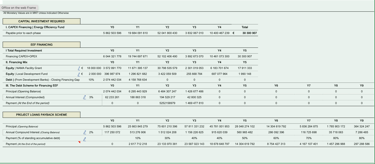
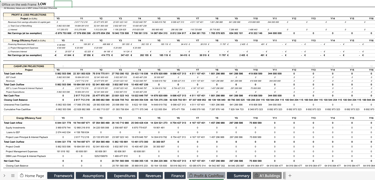
Integrated Financial Model comparing ESCO and direct contracting strategies
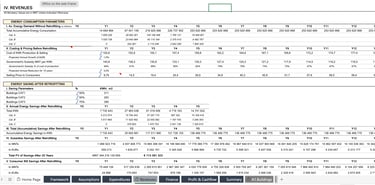
Expenditure & Revenue Projections across multi-year retrofit phases
Cash Flow & Payback Analysis under different subsidy and pricing scenarios
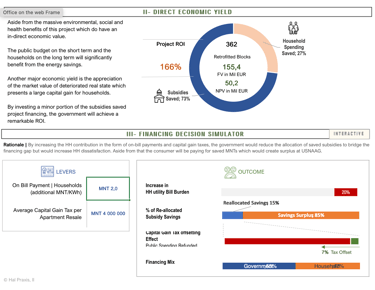
Executive Summary for Decision-Makers outlining the preferred model and rationale
Supporting Annexes covering building data, retrofit plans, and technical assumptions
The model was designed to be transparent, auditable, and adaptable for future project phases.
Project Impact
Clear Strategic Direction
The analysis demonstrated that an ESCO-based PPP model would add unnecessary cost and complexity in an immature market, while a fund-based public model maximized value for money.
Improved Financial Viability
The recommended structure achieved:
Lower weighted average cost of capital
Faster payback periods
Higher overall project solvency
Stronger Donor Confidence
The rigor and transparency of the financial model strengthened engagement with international climate finance institutions and development partners.
Deliverable Excerpts (Not Exhaustive)
© Hal Praxis 2025. All rights reserved.
Register Code: 304291595
Anapilio 30 Vilnius, Lithuania