
Working Capital Optimisation through Asset Turnover Gap Closure For Industrial Supplies Wholesaler
Helped the increase ROA by 32% within the first year of implementation.
Context
In asset-intensive trading businesses, working capital is the engine of growth. Inventory and receivables often represent the majority of invested resources, while operating cash is continuously recycled to meet short-term obligations.
In this engagement, the client was facing:
Constrained liquidity despite stable revenues
Declining return on invested capital
Limited ability to fund growth without external financing
With profit margins and leverage already under pressure, the only sustainable value lever available was better utilization of existing assets.
Objective
The objective of the project was to increase return on investment (ROI) by improving asset turnover, with a strong focus on:
Accounts Receivable turnover
Inventory turnover
Identification and elimination of “working capital drainers”
This initiative was positioned as a prerequisite to:
Any new investments
Resource reallocation
Future growth initiatives
Analytical Framework
The engagement was structured around a gap-closure methodology, built on four layers:
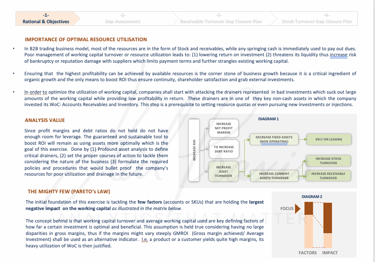
Rationale & Target Setting
Define a minimum viable asset turnover benchmark aligned with the business model
Quantify the performance gap between current and target utilization
Gap Assessment
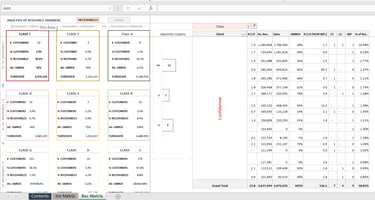
Analyze working capital concentration across receivables and inventory
Identify assets with high capital absorption but low economic return
Apply Pareto logic (“the mighty few”) to isolate the most damaging items
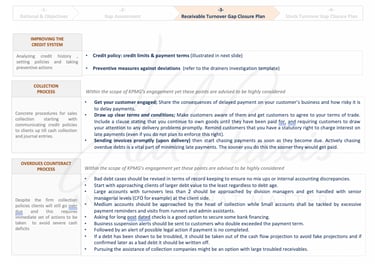
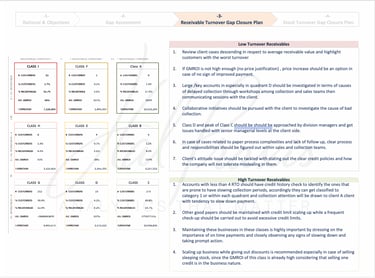
Receivables Turnover Gap Closure
Segment customers by turnover, exposure, and payment behavior
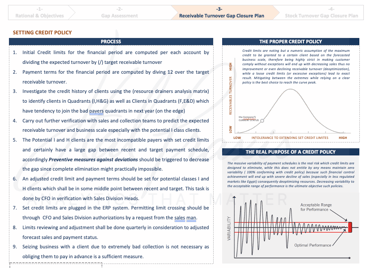
Introduce a structured credit policy framework balancing control and sales enablement
Define preventive and corrective actions for overdue and slow-paying accounts
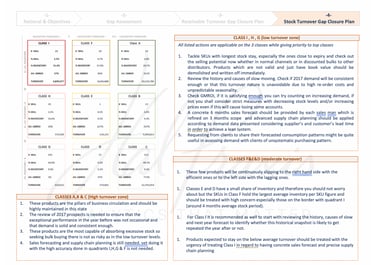
Inventory Turnover Gap Closure
Classify SKUs by stock duration, value, and GMROI
Separate strategic fast-moving items from capital-locking slow movers
Define differentiated actions per SKU class (pricing, write-offs, forecasting discipline)
Key Design Principles
1. Focus on Economic Reality, Not Averages
Rather than optimizing averages, the analysis focused on:
Incremental ROI
Capital intensity per customer / SKU
Justification of working capital usage via GMROI where margins varied
2. Controlled Flexibility
The credit policy was intentionally designed not to enforce zero deviation.
The goal was to:
Reduce harmful variability
Avoid sales destruction through over-control
Maintain commercial competitiveness in imperfect markets
3. Operational Ownership
Recommendations were translated into:
Clear decision rules
ERP-ready parameters (credit limits, review cycles)
Defined ownership between finance, sales, and collections
Deliverables
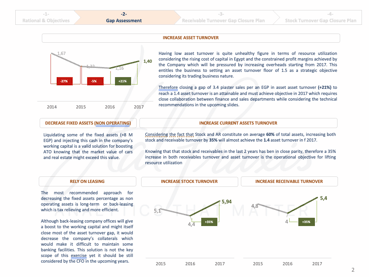
Asset turnover gap quantification and target roadmap
Working capital drainer identification matrix (customers & SKUs)
Credit policy design (limits, terms, escalation logic)
Receivables collection action playbook by customer class
Inventory segmentation and SKU-level action plans
Practical guidance for cross-functional execution (finance, sales, supply chain)
Business Impact
Without changing the business model or increasing leverage, the client achieved:
A clear and attainable path to double-digit improvement in asset turnover
Release of trapped working capital through better receivable and stock discipline
Improved liquidity resilience
A structurally stronger ROI profile driven by efficiency, not risk
Most importantly, the organisation gained a repeatable decision framework for preventing future working capital leakage.

Deliverable Excerpts (Not Exhaustive)
© Hal Praxis 2025. All rights reserved.
Register Code: 304291595
Anapilio 30 Vilnius, Lithuania